
Best cash flow forecasting software (2026)
The best cash flow forecasting software depends on what your books are in. Cash Flow Frog reads QuickBooks, Xero, Sage Intacct, Odoo, Zoho Books and FreshBooks, and forecasts 36 months from $69 a month. Most tools here read Xero and QuickBooks only. Under 180 days, your accounting software's own planner may be enough.
Cash Flow Frog makes one of the tools on this list. Every price and capability below was checked against the vendor's own pricing or product page on 6 September 2026, not against a software directory, because the directories disagree with each other and with the vendors. Where a vendor does not publish a price, this page says so rather than quoting a third party.
What is cash flow forecasting software?
Cash flow forecasting software connects to your accounting system and projects your future bank balance from the invoices, bills, purchase orders and payment history already in your books. It answers one question: how much cash will you have on a given date, and is that enough to cover what you owe.
Four different kinds of product get sold under this label, and they are not interchangeable. Dedicated forecasting tools do nothing but cash. Planners built into accounting software come free with the subscription and stop at a fixed horizon. Reporting and FP&A platforms treat cash as one output alongside profit and loss and balance sheet. Treasury systems handle multi-bank liquidity for companies running dozens of accounts.
Buying the wrong kind is the usual mistake. A business that wanted to know which week payroll gets tight ends up in a six-week FP&A implementation, or a group treasury function tries to run on a tool built for one bank account.
Direct and indirect, short and long
Two distinctions decide which tool fits, and vendors rarely spell them out.
Direct versus indirect method. A direct forecast is built from actual expected receipts and payments: this invoice lands on the 14th, that bill clears on the 20th. An indirect forecast starts from projected profit and adjusts for working capital movements. Direct is more accurate in the near term and is what you want for operational cash decisions. Indirect is what you want for a three-statement model that ties to a budget. Most dedicated cash tools, including Cash Flow Frog and Float, use the direct method. Fathom and the FP&A platforms lean indirect.
Short-term versus long-range. A 13-week cash flow answers whether you can pay people next month. A 12 to 36 month view answers whether you can afford the hire, the loan or the expansion. Tools that only do one of these will frustrate you six months in, which is why the forecast horizon column in the table below matters more than the feature lists most vendors lead with.
How this list was put together
Every tool here was assessed on four things: which accounting systems or banks it reads directly, how far ahead it forecasts, whether it publishes a price you can act on without a sales call, and whether you can start today or have to book a demo first.
Tools were excluded if they are FP&A or treasury platforms where cash is a by-product rather than the product, because that is a different purchase with a different budget. One tool that appears on most competing lists has been removed for a different reason, covered below.
Cash flow forecasting software compared
| Tool | Connects to | Forecast horizon | Starting price |
|---|---|---|---|
| Cash Flow Frog | QuickBooks Online, QuickBooks Desktop, Xero, Sage Intacct, Odoo, Zoho Books, FreshBooks, Plaid bank feeds, Excel import | 36 months rolling | $69/mo, $55/mo billed yearly. Published. |
| Float | Xero, QuickBooks Online | 12 months on Essentials, 36 months on Growth and Scale | $130/mo, $105/mo billed yearly, USD. Published. |
| Fathom | QuickBooks, Xero and other ledgers | Up to 5 years, three-statement | A$59/mo for one company, plus A$59 per extra. Published. |
| Futrli | Xero, QuickBooks Online, Sage, Excel uploads | 3 years, three-statement | $40/mo for 1 to 5 licences, excl. VAT. Published. |
| Dryrun | QuickBooks Online, Xero, Sage Intacct, Dynamics 365 | Daily, 13-week and monthly | Not published. Directories list a Business plan near $249/mo. |
| Xero Analytics, powered by Syft | Xero | 30 to 180 days by Xero plan tier | Included with eligible Xero plans. |
| QuickBooks Cash Flow Planner | QuickBooks Online | Up to 24 months | Included with QuickBooks Online. |
| Sage Intacct planning | Sage Intacct | Aligned to the budget cycle | Not published. Sales-led. |
| Odoo | Odoo | No native forecast, Apps Store modules only | Varies by module. |
| Agicap | 300+ UK, Irish and international banks | Treasury horizons | Not published. 12-month minimum term. |
Of the standalone tools here, four publish a price you can act on. The rest route you through a demo before you learn the cost, which is worth knowing when you plan an evaluation. The two planners built into Xero and QuickBooks carry no separate charge at all.
Cash Flow Frog
Best for: a growing business or an accounting practice that wants a rolling three-year cash forecast built from the books, without a demo call or an implementation project.
Consider something else if: you need a three-statement model, or you are running group treasury across dozens of bank accounts.
What it reads
Cash Flow Frog connects to QuickBooks Online, QuickBooks Desktop, Xero, Sage Intacct, Odoo, Zoho Books and FreshBooks. If you are not on accounting software, it can pull bank transactions through Plaid or from an Excel or CSV import. For comparison, Float reads two ledgers. Dryrun adds Sage Intacct and Dynamics 365. Neither reads Odoo or Zoho Books, and neither imports bank transactions from Excel.
It reads outstanding invoices, bills, purchase orders and estimates, then refreshes every day. Click any figure in the forecast and the invoices and bills behind it open. The forecast runs 36 months rolling, with daily, weekly, monthly and quarterly views, so a 13-week cash flow and a three-year plan come out of the same data.
Collection dates based on how your customers actually pay
A forecast built on invoice due dates is wrong for most businesses, because customers do not pay on the due date. Cash Flow Frog analyses each customer's payment history and shifts the expected collection date to match. A customer who reliably pays 20 days late is modelled that way rather than optimistically.
Rule-based projections
Recurring lines do not need re-typing every month. You define the logic once and the forecast recalculates from your own history. Four rule types are available:
- Rolling average over a lookback window you set, for costs that move around but stay in a range.
- Carry forward last month, for stable recurring costs.
- A percentage of revenue, for commissions, materials and anything that moves with income.
- Same month last year plus a growth rate, for seasonal businesses.
Set on the Projections screen with the rule-based amount toggle, with a lookback window, duration, filter and formula.
Forecasting by class, tracking category and dimension
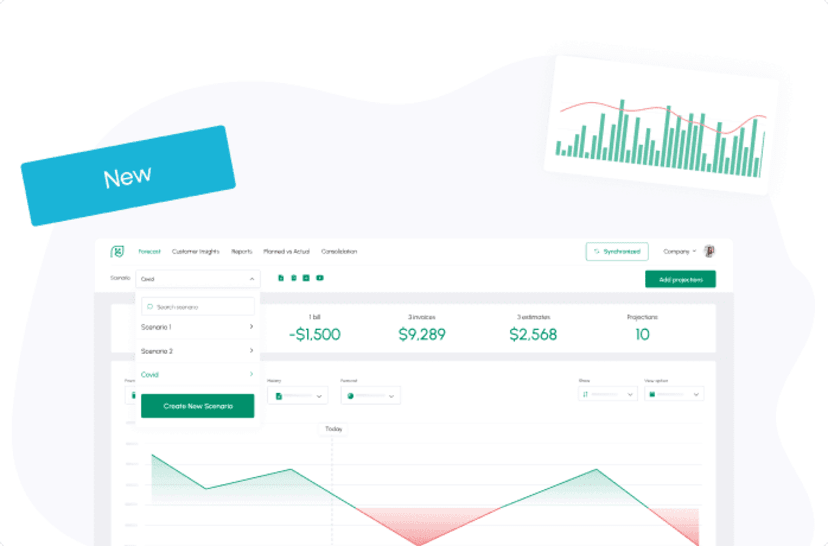
If you already track cost centres, departments or locations in your accounting software, the forecast follows that structure instead of flattening it. QuickBooks Classes, Xero tracking categories, and Sage Intacct dimensions including entity, location, class, project and department all come through as breakdown levels. Most tools in this category read ledger totals only, so this is the question to put to any vendor here if you run more than one cost centre.
An MCP connector for Claude, ChatGPT, Copilot and Gemini
Cash Flow Frog has an AI connector built on MCP. Connect your assistant and it gets live access to your invoices, bills, bank data and forecast, so it answers from your real numbers rather than a pasted spreadsheet. Ask what happens to runway if revenue drops 10%, add next quarter's contractor costs by describing them, or run a what-if, and the forecast updates as you go.
Agicap ships an MCP server as well, so this is not unique to Cash Flow Frog. Among the tools here that you can buy without a sales call, it currently is.
What it costs and what is included
Pricing is published by annual revenue band: $69 a month up to $1M in revenue, rising to $249 a month above $20M, with annual billing 20% lower. Nothing is quote-based, so you know the cost before you sign up.
The yearly plan currently carries a 40% early bird discount on top of that. On the entry tier it works out at $33 a month, billed $396 for the year against $828 paid monthly, which is $432 saved. A two-year term brings it to $27 a month, billed $648. These are promotional rates rather than list pricing, so check the pricing page for the current offer.
Included at every tier: a 14-day trial with no credit card, a 1-on-1 onboarding session, no implementation fee, and a 30-day money-back guarantee. Cash Flow Frog is rated 4.8 on Capterra and the Xero App Store, and 4.6 on the QuickBooks App Marketplace.
Float
Best for: a Xero or QuickBooks Online business that wants a visual forecast with a strong 13-week view and does not need a second ledger.
Consider something else if: your books are in Sage Intacct, Odoo or Zoho Books, or you need past 12 months on the entry plan.
Float reads bills and invoices from Xero or QuickBooks Online using the direct method and builds a visual cash forecast with scenarios and budget versus actual reporting. The interface is among the better ones in this category. Every plan includes unlimited users, eight scenarios and a 13-week cash flow.
Two things to check before committing. Float connects only to Xero and QuickBooks Online, with Sage Intacct listed as coming soon. And the entry Essentials plan, at $130 a month or $105 billed yearly in USD, caps the forecast at 12 months. The 36-month horizon sits on Growth, at $265 a month or $215 billed yearly, which is where the price gap against a cheaper tool opens up. Multi-entity consolidation is Scale only, at $389 a month or $315 billed yearly.
Read the full breakdown in our Cash Flow Frog vs Float comparison.
Fathom
Best for: advisors and finance teams who want three-statement forecasting and client reporting in one product, with cash as one output.
Consider something else if: the cash forecast is the whole job and you do not need reporting packs.
Fathom does profit and loss, balance sheet and cash flow together, with forecasts up to five years and a reporting layer built for client-facing packs. Cash flow forecasting is included on every plan, along with unlimited users and multi-currency consolidations.
Pricing runs per connected company and is published: A$59 a month for one company plus A$59 per extra, A$315 for ten, A$450 for twenty-five, A$805 for fifty. Prices display in Australian dollars excluding GST, which is why software directories quote wildly different figures for Fathom. The per-company model suits an accounting firm with a client portfolio and is expensive for a single business that only wants a cash view.
See the detail in our Cash Flow Frog vs Fathom comparison.
Futrli
Best for: accountants and advisers who want three-way forecasting and reporting across a client book, on Xero, QuickBooks Online or Sage.
Consider something else if: your books are in QuickBooks Desktop, Odoo or Zoho Books, or you want a cash-only forecast you can drill to the invoice.
Futrli, now owned by Sage, predicts profit and loss, balance sheet and cash flow together from your accounting data, with 3-year forecasts, daily cash flow, budgets and scenario modelling, and customisable reporting. It connects to Xero, QuickBooks Online and Sage, with Excel uploads for other data. P: Pricing is published. The Single plan is $40 a month excluding VAT for one to five licences, and practice plans start at $250 a month for six to 18 clients. Every plan includes unlimited users and a 14-day trial with no credit card.
Our Cash Flow Frog vs Futrli comparison has the full table.
Dryrun
Best for: mid-market finance teams on an ERP who want manual control over every line of the forecast.
Consider something else if: you want to start today, or you need a published price for a budget approval.
Dryrun connects to QuickBooks Online and Xero and to ERPs including Sage Intacct and Dynamics 365. Its argument against automated forecasting is manual authority: you override expected collection and payment dates invoice by invoice, or set client-level and vendor-level payment lag, and compare scenario layers side by side.
Dryrun does not publish pricing on its site. Software directories list a Business plan starting near $249 a month for three users on an annual contract, with higher tiers quote-based, and those figures disagree with each other, so treat them as a range rather than a number. Buying is demo-led and ERP-connected plans involve an implementation process.
Our Cash Flow Frog vs Dryrun comparison puts the two side by side.
Xero Analytics, powered by Syft
Best for: Xero users whose planning question is about the next few months.
Consider something else if: you plan past 180 days or need scenario modelling.
Xero has native cash flow forecasting. Xero Analytics, built on Syft after Xero acquired Syft Analytics, projects your cash position 30 to 180 days ahead depending on your plan tier, and it is included with eligible plans at no extra cost. For a business that wants to know whether next quarter is covered, that is often enough on its own, and paying for a second tool would be waste.
Beyond 180 days you need something else, and scenario modelling and transaction-level drill-down are not part of the native view. Our Cash Flow Frog vs Xero Analytics comparison covers where the line sits. Syft is also still sold as a standalone product outside Xero, and our Cash Flow Frog vs Syft comparison covers that version.
QuickBooks Cash Flow Planner
Best for: QuickBooks Online users who want a cash view without adding a subscription.
Consider something else if: you need weekly or daily granularity, or scenarios.
The Cash Flow Planner is included with QuickBooks Online and shows your projected cash position month by month, up to 24 months ahead. It costs nothing extra and is a reasonable starting point.
QuickBooks records what happened. A dedicated forecasting tool projects what is coming, in daily and weekly views as well as monthly, which is what you need to run a 13-week cash flow and see exactly which week a payroll run or a tax payment lands. Our Cash Flow Frog vs QuickBooks Cash Flow Planner comparison has the full table.
Sage Intacct planning
Best for: Sage Intacct customers whose planning already runs on an annual budget cycle.
Consider something else if: you need a 13-week cash view without a partner implementation.
Sage Intacct's planning module handles budget-based planning, typically monthly, tied to the plan cycle. A 13-week cash flow is not a standard output, and getting one usually means partner-led implementation. Pricing is not published.
Cash Flow Frog reads Sage Intacct directly, including dimensions for entity, location, class, project and department, which is the usual route when the cash view is the specific gap. See the Cash Flow Frog vs Sage Intacct comparison.
Odoo
Best for: Odoo users who need to add forecasting, because Odoo's accounting app reports on cash that has already moved rather than projecting it forward.
Odoo's accounting app produces a historical cash flow statement. Forward-looking forecasting comes from third-party modules on the Odoo Apps Store, and quality varies a lot between them.
Cash Flow Frog connects to Odoo directly and builds the 36-month rolling forecast from Odoo data. Details in our Cash Flow Frog vs Odoo comparison.
Agicap
Best for: European mid-market finance and treasury teams working across many bank accounts.
Consider something else if: you want a short commitment or a published price.
Agicap connects to more than 300 UK, Irish and international banks and covers cash flow, payables and receivables, and forecasting for multi-entity groups. It also ships an MCP server, so an AI assistant can query live treasury data.
Pricing is not published. The subscription is annual with a minimum 12-month term, and evaluation runs through a session with an Agicap expert rather than a self- serve trial. Our Cash Flow Frog vs Agicap comparison covers where the two differ.
A note on CashFlowTool
CashFlowTool appears on most competing lists for this search, and on older versions of this page. It was retired on 21 November 2025. CashFlowTool Lite and CashFlowTool Pro were both discontinued along with every subscription plan, and the domain now redirects to an end-of-life FAQ on the Crunchafi site. A list that still recommends it has not been checked since 2025. If you used CashFlowTool with QuickBooks, our CashFlowTool alternative for QuickBooks page covers the switch.
CashAnalytics also turns up on these lists as a standalone product. It was acquired by GTreasury in September 2024 and is now sold as part of GTreasury's treasury suite rather than on its own, and cashanalytics.com is not currently serving. Either way it was built for corporate treasury teams running multi-bank liquidity, not for an owner-managed business.
What these tools do not solve
A forecast is only as good as the data underneath it, and nothing on this list fixes the following.
- Bookkeeping that is behind. If bills are entered a month late, every forecast built from your ledger inherits that lag. Software makes stale data prettier, not fresher.
- Revenue you have not contracted. Pipeline is a guess in every one of these tools. The accuracy you get on the receivables side does not carry over to new business.
- The decision itself. Knowing that cash gets tight in week nine is useful only if someone then chases the invoice, delays the order or draws on the facility.
- Bank balances outside the ledger. If money moves through accounts your accounting software never sees, you need direct bank connections rather than a ledger-only tool.
What to look for when comparing
Six questions separate these products in practice.
- Does it read your ledger? Most of this category supports Xero and QuickBooks Online only. Sage Intacct, Odoo and Zoho Books narrow the field fast.
- How far ahead, on the plan you would actually buy? Vendors quote the horizon on their top tier. Check the entry plan.
- Daily and weekly views, or monthly only? A 13-week cash flow needs weekly granularity. Monthly-only tools hide the week payroll lands.
- Can you drill from a forecast figure to the transactions? Without it, you cannot explain a number to a lender or a board.
- Does it follow your tracking dimensions? Classes, tracking categories and Intacct dimensions matter the moment you have more than one cost centre.
- Published price, or a demo? Four of the tools here publish. The rest need a sales conversation before you know the cost.
What is the best app for cash flow forecasting?
The answer comes down to horizon and ledger, and the ledger narrows the field first. If your books are in Sage Intacct, the third-party options here come down to Cash Flow Frog and Dryrun, with Float on a waitlist. For Odoo or Zoho Books it is Cash Flow Frog alone. On Xero or QuickBooks Online you have the whole field, and if you only need the next 90 to 180 days the planner already included in your subscription will do the job and cost nothing.
Among dedicated apps, Cash Flow Frog and Float are the two most often compared at the lower end of the price range. Cash Flow Frog runs to 36 months on every plan and connects to more ledgers, including Sage Intacct and Odoo. Float has a polished interface and a strong 13-week view. Fathom suits an accounting firm billing across a client portfolio. Dryrun and Agicap sit further up-market, where the buyer has an ERP or a treasury function.
What is the best app for cash flow prediction?
Cash flow prediction and cash flow forecasting describe the same job, and the same tools cover both. The difference in practice is how the projection gets built.
Some tools ask you to enter expected income and costs yourself. Others read what is already in your books, outstanding invoices, unpaid bills, open purchase orders, and project from actual payment history. Cash Flow Frog analyses each customer's payment habits and adjusts the expected collection date accordingly, so a customer who reliably pays 20 days late is modelled that way rather than at the invoice due date. If you want prediction based on your own data rather than your own guesses, that distinction is the one to ask vendors about.
How do I create a cash flow forecast?
Start with your opening bank balance. Add expected cash in, which for most businesses means unpaid customer invoices with a realistic collection date rather than the invoice due date. Subtract expected cash out: supplier bills, payroll, rent, loan repayments, tax. The running balance across each week or month is your forecast.
Two things decide whether it is any use. The collection dates have to reflect how your customers actually pay, and the forecast has to be updated as new invoices and bills come in. A forecast built once and left alone is out of date within a fortnight, which is the main argument for connecting a tool to your accounting software instead of maintaining it by hand.
How can I create a cash flow forecast in Excel?
Set up one column per week or month. Row one is your opening balance. Below it, group your cash inflows: customer receipts, loans, other income. Then your outflows: payroll, suppliers, rent, tax, loan repayments. Net the two, add the result to the opening balance, and carry the closing balance across to the next column as its opening balance.
Export your open invoices and bills from your accounting software to fill in the near-term columns rather than typing figures from memory. For the months further out, base each line on the same month last year, adjusted for what you know has changed.
Excel works fine for a first forecast. It stops working well when someone has to rebuild it every week, when more than one person edits it, or when you need to compare a hiring scenario against a no-hiring scenario without duplicating the whole file. That is the point at which most businesses move to a tool.
How to choose
Answer two questions before you look at any product page. How far ahead do you need to see, and what accounting software are your books in?
If the answer is 180 days or less on Xero, or 24 months or less on QuickBooks Online, use what you already pay for. If you need longer, or you need daily and weekly views, scenarios, or drill-down from a forecast figure to the transactions behind it, a dedicated tool earns its cost. If your books are in Sage Intacct, Odoo or Zoho Books, that narrows the field quickly, because most tools in this category only connect to Xero and QuickBooks. For a worked example built around an owner-managed business, see our guide to cash flow forecasting software for small business, or the industry guides if your cash cycle is specific to construction, ecommerce or professional services.
Cash flow forecasting is the part of financial planning that decides whether you can make payroll in November, take on the new hire, or wait another month before chasing a slow customer. Everything above is a way of getting to that answer faster and keeping it current. Cash Flow Frog builds a rolling 36-month forecast from your accounting data, refreshed daily, with a 14-day trial and no credit card. If you want to read more first, our cash flow forecasting best practices guide covers how to keep a forecast accurate once it is running, and the glossary defines the terms used above.
Prices and capabilities on this page were checked against each vendor's own site on 6 September 2026. Vendors change pricing without notice, so follow the links before you buy.

QuickBooks class tracking in Cash Flow Frog
Read more

10 Best Cash Flow Business Ideas: Build Income That Counts
Read more

What Is an MCA? Merchant Cash Advance Meaning, Cost & Risks
Read more
10 Cash Flow Management Tips You Can Put to Work Today
Read more

How to Do a Market Analysis in a Business Plan
Read more
Customer Insight Analyst
Read more
Understanding Cash Flow Forecasting: Tips and Best Practices
Read more
The Importance of Sales Forecasting: A Guide for Business Success
Read more

8 Ways to Improve Manufacturing Cash Flow
Read more
Trusted by thousands of business owners
Start Free Trial Now