
What Are Variable Costs? The Simple Formula + Real Business Examples

Businesses have many costs, but many entrepreneurs fail to understand them. And one of those costs is variable costs.
But what is variable cost, and why is it important in business finance and accounting?
This article examines these costs, their importance, and how you can make the most out of these costs to keep your business profitable.
Variable Costs Definition
Every business spends on something. A bakery would spend on its raw materials, equipment, and bakers, while a consulting agency would have the majority of its costs on software, consultants’ salaries, and office supplies.
However, these costs aren’t constant. Many business expenses rise and fall with activity levels. These are the variable costs.
But what really is the variable cost meaning? These are costs that are directly tied to your level of activity. This means that the more goods you sell, the higher your total variable costs will be.
So, unlike your rent and subscriptions, which stay the same each month, this cost changes as your business grows.
Variable Cost Examples You’ll Recognize
Knowing its definition might help, but knowing what these costs actually are in your business will help you fully understand its importance and effect on your business.
Here are some examples of variable costs in business:
Direct Materials and Packaging
These are spent on manufacturing and packaging products, such as:
- Raw materials
- Product components
- Packaging
- Labels
For example, you own a bakery. The ingredients for each pastry, from the flour to the toppings, form part of your raw materials. If you accept take-outs and deliveries, the packaging you put them in and the labels will also count in your variable cost.
Because it’s directly connected to your operations, direct materials and packaging are parts of your COGS/cost of sales, which are then subtracted from your sales to get the gross margin.
Direct Labor and Contractor Costs

Image: Workers in the production line | EqualStock via Unsplash
Not all businesses pay employees a fixed wage. This is particularly present in manufacturing businesses where employees are paid per unit produced. Some other examples include:
- Freelancers are paid per project
- Contractors are paid per hour for billable work.
Say, you run a marketing agency. The more clients you bring in, the more projects you’ll work on. This increase in work will prompt you to hire more freelancers, who will bill you for the hours they work or the projects they complete.
And this flexibility is the core of the variable cost definition in action.
Sales Commissions and Transaction Fees
You might think it’s a different cost, but sales commissions and transactions are also examples of variable costs.
Why? It’s because they’re highly dependent on the amount of sales your reps make. So, if there’s no sale, they can’t earn any commission.
This also happens in many transactions in your business that require fees, such as:
- Credit card processing fees
- Payment gateway fees
- Marketplace commission
Commissions and transaction fees are directly tied to your revenue, so it’s only right to include them in your variable costs.
Shipping, Fulfillment, and Returns
Many businesses today operate online, and some costs associated with online operations will also be included per the variable costs definition in business. These costs include the following:
- Shipping fees per order
- Fulfillment center charges
- Packaging supplies
- Return processing costs
As the order volume increases, these costs also rise, making them variable or changing.
And if you’ve ever wondered what variable cost is in the e-commerce context, just look at your shipping dashboard.
Want to know how variable costs your numbers affect?
Try our financial forecasting feature todayHow Do I Calculate Variable Costs?

Image: Computing costs | Freepik
While its meaning is straightforward to understand, understanding the variable cost formula will help you further analyze its concept and aid in decision-making.
Here are the different ways you can compute the variable cost.
Total variable cost = Units × Variable cost per unit
This formula tells you the total variable cost for a given production or sales volume.
Let’s say you sold 500 units of a product and you spent $9 in producing each unit. Your total will be:
500 units × $9 = $4,500
That’s how much your costs move with those sales.
Variable cost per unit = (Total variable costs ÷ Units)
If you have the totals instead, you can use this formula to determine your per-unit costs.
Let’s use the same example. If you spent a total of $4,500 but you instead sold 1000 units, your variable cost per unit will be:
$4,500 ÷ 1000 units = $4.5 per unit
The VCU is especially important as it helps you with the following:
- Pricing
- Margins
- Unit economics
- Profit scalability.
Understanding the VCU will help you assess your pricing strategies and margins so you can ensure you can scale without reducing profit.
Where the Numbers Usually Sit in Your Books
Accounting-wise, you can find variable costs in:
- Cost of goods sold / Cost of sales
- Direct labor expenses
- Merchant fees
- Shipping fulfillment
And these expenses directly affect your gross profit. They are also important in your cash flow forecasting, as these costs fluctuate with your revenue. If your projected revenues are off, it’s likely that our projected expenses will be, too.
Variable Costs vs Fixed Costs
As indicated in the variable cost meaning, not all costs move with sales. So, what do you call those expenses that stay the same?
You call them fixed costs. These costs remain constant regardless of your output. Some of these include:
- Rent
- Insurance
- Salaried employees
- Software subscriptions.
Let’s go back to the bakery. Even if sales increase, the rent doesn’t. The same goes for your manager’s salary.
But, there’s also a cost that’s a mixture of both. Called the semi-variable costs / mixed costs, these expenses have fixed and variable components.
A great example is your electricity bill. It’s composed of fixed charges for the meter and variable ones for your usage. Although there’s a fixed base, the more you use it, the higher your bill will be.
When you understand how all three types of costs impact your business, you can make more informed decisions about your operations, especially when it’s slow.
Interested in knowing how your costs affect your overall profitability?
Sign up for Cash Flow FrogWhy Variable Costs Matter for Profit and Cash
If you set variable costs aside in decision-making, you’ll likely squeeze your profit, strain your cash, and put pressure on your current assets.
Here’s how it affects your profit and cash.
Pricing and Contribution Margin

Image: Prices on different products | Alan Alves via Unsplash
This is how much you earn after you deduct your VC from your selling price. The contribution margin tells you how much your sales per unit can cover fixed costs and generate profit.
So, when the margin’s too small, scaling your business won’t help much, and you won’t be as profitable as you thought you’d be.
Break-Even and Volume Decisions
You use the break-even analysis to determine how many units you’ll need to sell to cover all costs, fixed and variable included.
And its computation directly depends on your variable costs. When the cost is lower, you’ll need fewer units to break even. But if variable costs are higher, you will need to produce more units to break even.
This concept is also related to your marginal cost, which is the cost of producing one more unit. If your marginal cost is low, growing your production will look attractive. But if it’s high, aggressive growth will only hurt your cash position.
Variable Costs in Forecasting
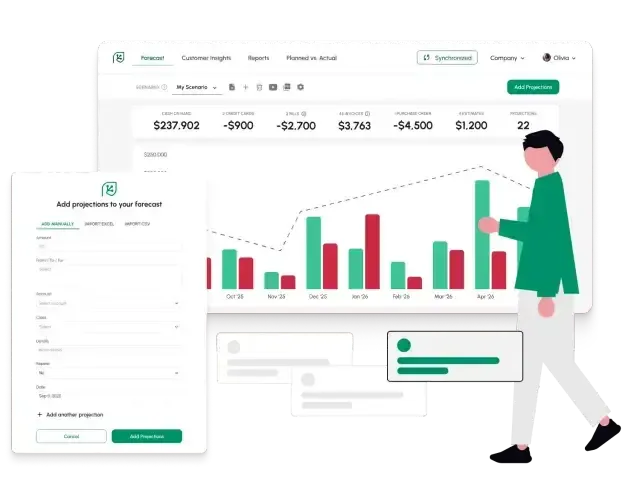
Image: Forecasts using Cash Flow Frog | Cash Flow Frog
Forecasting your numbers without understanding variable costs will only lead you into trouble, even if you use cash flow software. Here’s how you can make the most of this cost when you’re making projections.
Tie Variable Costs to Drivers
Variable costs don't just appear randomly; they’re a result of something in your process. So, tie them to the actual activity.
Here are some examples of variable costs and their drivers:
| Variable Cost | Driver |
|---|---|
| Raw materials cost | Units sold |
| Shipping and packaging fees | Orders shipped |
| Payment processing fees | Transactions processed |
| Contractor expenses | Hours billed |
| Commissions | Sales closed |
So, instead of treating it as one big total, link variable costs to drivers to make your forecasts more accurate and flexible.
Build a Simple Cost Model by Category
Group your variable costs into clear categories:
- Production
- Labor
- Sales
- Delivery
Then assign cost-per-unit assumptions to each. This creates a flexible model that helps you project your profit, cash position, and required working capital.
Using a simple yet categorized cost model also improves visibility into current assets and current liabilities, especially when scaling operations.
How to Reduce Variable Costs Without Hurting Quality
Many businesses resort to cutting variable costs to maximize profit, but how can you do it without hurting quality? Here are some ways you can reduce costs without sacrificing anything:
Supplier Terms and Pricing

Image: Reviewing supplier contract | Freepik
If you can’t entirely switch suppliers, you can re-negotiate the terms and pricing to reduce the VCU. Here’s how you can do it:
- Use bulk discounts and renegotiate the price per unit.
- Change upfront payments to Net 30 to protect your cash position.
Doing this will reduce the price per unit and improve when you pay it, ultimately improving margins without touching quality.
Process Fixes: Waste, Rework, Returns
Sometimes, it’s not the pricing that increases your variable costs, but the inefficiencies in your production line. You should look for the following:
- Waste: Excess materials, overproduction, damaged goods
- Rework: Fixing mistakes, correcting defects, repeating tasks
- Returns: Refunded orders, reverse shipping, replacement costs
When you can improve your operations, you’ll stop paying twice for the same sale.
Smarter Commissions and Incentives
Smarter commissions mean rewarding profitable behavior, not just higher revenue. You should instead:
- Incentivize higher-margin products
- Tie bonuses to contribution margin, not sales revenue
- Set thresholds to protect your profitability.
These strategies help your reps to make sales that strengthen profit and cash, not just top-line growth.
Common Variable Cost Mistakes
At a glance, you might be in control of your variable costs, but when you look deeper, you might be misjudging them. Here are some frequent mistakes even experienced entrepreneurs make when dealing with these costs:
- Underestimating small per-unit fees. They might be little, but they can add up to something material.
- Disregarding transaction costs. Not accounting for them will make your computations and forecasts inaccurate.
- Ignoring seasonal spikes. Your business isn’t steady all year long, and looking at your past data can help you anticipate the surge in sales and costs.
- Treating mixed costs as fixed. Separate the variable from the fixed to make your projections realistic, adjusting as you scale.
- Not updating assumptions. Businesses and seasons change, so updating your forecasts will always help you stay grounded.
Using tools like Cash Flow Frog can help you avoid these mistakes and keep your projections practical and realistic.
Summary: Variable Costs at a Glance
In a nutshell:
- Variable costs change with production or sales volume, directly impacting your margins, pricing, and profitability.
- Understanding the formula can help you manage and forecast your cash flow, plan for break-even, and protect your current assets and profits.
- There are ways you can reduce variable costs without affecting quality, focusing on optimizing your processes and renegotiating supplier terms and sales commissions.
Related Terms
FAQ
Looking for more help?
Visit our help center to find answers to your questions about CashFlowFrog.
Trusted by thousands of business owners
Start Free Trial Now